
Debt notebook: how to track customer credit on a phone
Published: 2026-06-19 · 7 min read
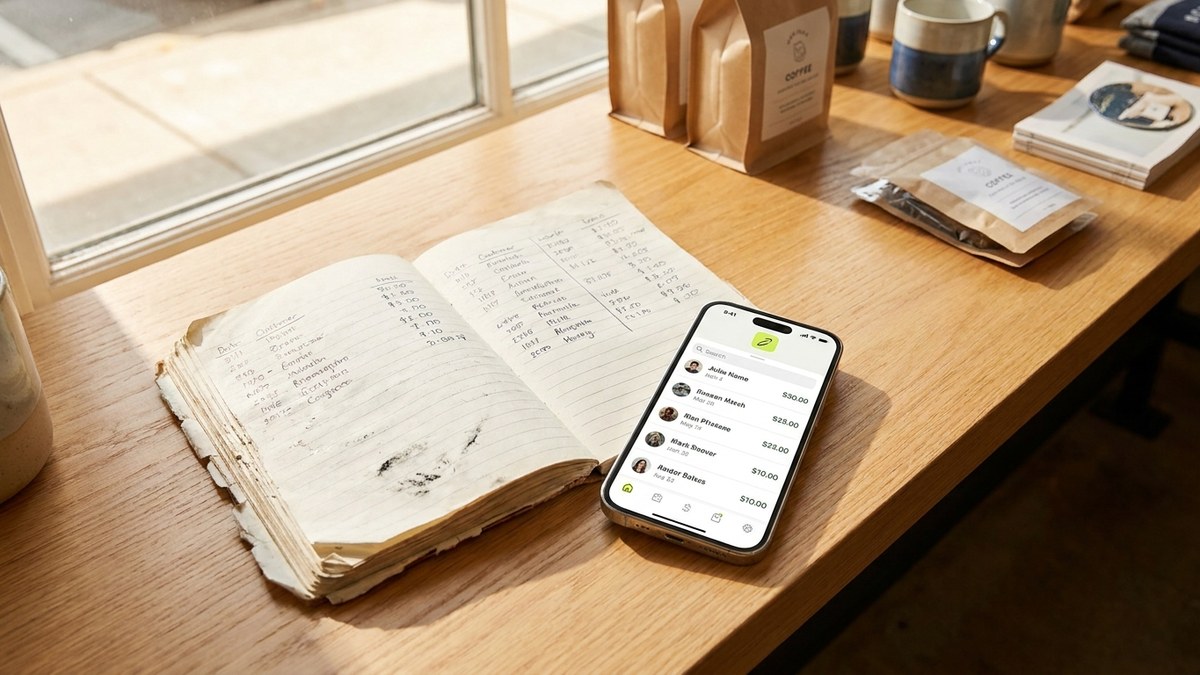
At the end of the day you open the debt notebook and try to remember: did this neighbor take the sausage on credit or has he paid it back, and why is that line crossed out, because he topped it up or because you stopped trusting him. The notebook knows everything, as long as it stays whole and you still recognize your own handwriting.
The problem is not that paper is old-fashioned. The problem is that a debt in a notebook lives apart from your sales and apart from your memory. One spilled tea, one torn-out page, one day with someone else behind the counter instead of you, and there is nothing left to settle a dispute with.
Below we cover not only what to use instead of a debt notebook, but the real question hidden underneath it: should you sell on credit at all, and how to make that credit work for you instead of quietly draining away.
Why a debt notebook fails exactly when you need it
A notebook is reliable right up to the first dispute. The customer says he paid, you show the entry, he replies that he topped it up later and you simply did not cross it out. There is no proof, the relationship with a regular is worth more than the amount, and you write the debt off in your head.
Its second weak spot is that only its owner understands it. The moment you step out for half a day and put your son or a clerk at the till, the unfamiliar handwriting and shorthand turn into a puzzle. Someone takes credit, no entry appears, and by evening the total does not add up.
Most of all: to know how much you are owed in total and whose due date has passed, you have to leaf through the notebook page by page. By the time you finish leafing, the moment to call the debtor has already gone.
- The record sits in one place, lose the notebook and you lose the debts.
- A wet or crossed-out line can no longer be read.
- Another cashier cannot read your handwriting or close the count.
- You cannot state the total debt without leafing through it all.
- Overdue due dates hide between the ordinary entries.
What replaces a debt notebook: tracking credit on a phone
The debt notebook kept the count for years, and what needs changing is not the habit but its fragility. In BirLiy customer debts appear in the app instead of the notebook: who owes how much and when they promised to pay, all in one list on your phone.
Each customer has a separate entry. When the customer pays back part of the amount, the balance updates on its own, and you do not recalculate in your head at every visit. The payment history is saved, so in a dispute you lean on a record, not only on memory.
Overdue debts are gathered into a separate list. In the morning you open the phone and see at once who needs a reminder, without leafing through anything.
Should you sell on credit: when it holds the shop, when it drags it down
For a corner shop, nasiya is not weakness but a way to keep the neighbor who would otherwise cross the street. The regular you trust until payday comes back to you specifically, and over time that is your revenue.
The same debt drags you down when it has no face, no date, and no ceiling. To a stranger, with no stated return date, with no entry made on the spot, it is better not to give credit. It is not the debt itself that is dangerous but debt without limits, which you only notice once there is too much of it.
A simple way to decide on the spot: give each customer a limit that makes sense to you, and hold it. In BirLiy you can set a debt limit per customer, and when the amount nears it, the app reminds you. You make the decision, and the phone holds the memory for you.
- Credit yes: a regular, trusted, with a stated date and a ceiling on the amount.
- Credit carefully: a new customer, a small amount, a short term.
- Credit no: a stranger, no due date, no limit, no entry on the spot.
A debt is the same sale, just paid for later
Another weakness of the notebook is that it is cut off from the shelf. The sausage went out on credit, it is not in the sales, on paper it is still in stock, and by evening the count does not match for no clear reason.
In BirLiy a product given on credit is recorded as a sale and reduces the stock on hand the same way a cash sale does. Whether you handed it over for cash, by QR, or on credit, the stock stays correct in all three cases.
At the end of the day the owner sees both the sold goods and the unpaid debts in one place. There is no need to reconcile the notebook against the till and the stock separately.
How to move your debts onto the phone without losing one
Switching to tracking credit on a phone needs no new hardware, an ordinary smartphone is enough. If the shop loses internet, BirLiy keeps working in offline mode, and when the connection returns the entries sync on their own.
The starting debts from the notebook are entered once: the customer's name, the amount, the return date. After that each new debt and each partial payment is recorded in a few seconds, right in front of the customer.
- Select the customer or add a new one.
- Add the item and the amount taken on credit.
- Set the date by which they promised to pay back.
- On a top-up enter the amount, the balance recalculates itself.
- View overdue debts as a separate list when it is time to remind.
Move your debt notebook into BirLiy: see on your phone who owes how much and when they promised to pay back. We are now opening early access for the first shops in Tashkent, and the team helps with the switch.
Leave a requestRelated articles

How to Choose Shop Management Software? Key Features
A guide for Uzbekistan shop owners on choosing the right software. Must-have features, common mistakes, and local considerations. Find what really works.
Read article
Cash register software cost in Uzbekistan: Prices & features
Wondering how much cash register software costs in Uzbekistan? From a free notebook to 149 000 som monthly. Find out what small shops actually pay and what you get.
Read article